Tag Archives: drawing

Pastel Pencils: The Quest for the Best

The quest for the best brand of pastel pencil for portrait drawing is a subject I have seen discussed all over the web, and, in my search for the ideal tool, is something I have researched extensively. However, my choice of pastel pencil will vary from other artists’ as I don’t limit myself to a single brand.

Buying (or receiving a gift of) a tin of pastel pencils, to get you started, is a common reason for singling out a particular brand. This may appear economical but it is worth considering starting with a selection of open-stock pencils and adding to your collection as needed. In buying a set, you will always be left with colours that sit unused for years. And conversely, however big a set you buy, you will always be left wanting.
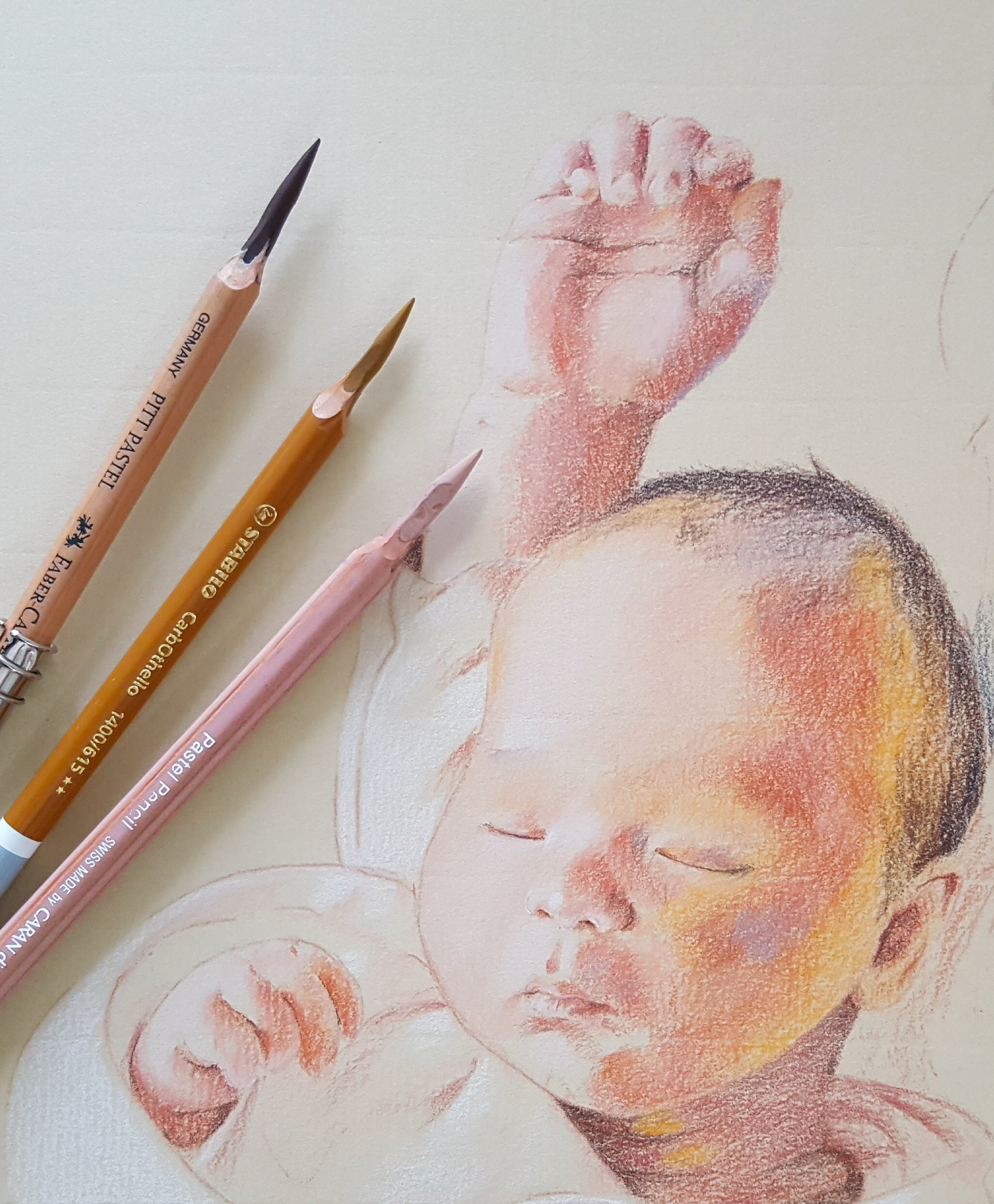
Array of Pastel Pencils

[custom_headline type=”left” level=”h2″ looks_like=”h5″ accent=”true”]The Choices[/custom_headline]

[custom_headline type=”left” level=”h3″ looks_like=”h6″ accent=”true”]Faber-Castell Pitt[/custom_headline]

Following the advice of other artists (Colin Bradley, Art Tutor and others) I bought a good selection of portrait-type colours in Faber-Castell Pitt Pastel Pencils. I find them firm enough to allow good control and with a decent amount of pigment. They are certainly a good choice and have a reasonable range of colours. But, they’re not my favourite.

[custom_headline type=”left” level=”h3″ looks_like=”h6″ accent=”true”]Conté[/custom_headline]

Actually my least favourite. As well as the core often arriving shattered, these are hard and scratchy with an apparently high chalk content. I will avoid in future.

[custom_headline type=”left” level=”h3″ looks_like=”h6″ accent=”true”]Derwent[/custom_headline]

My regular online supplier, Jackson’s offer an excellent choice in open stock, so I have tried quite a few. However, my modest collection of Derwent pastel pencils originates mostly from tins I bought long before I had the world wide web of pastel choice available to me (yep, that was a very long time ago!). As you might expect, they haven’t aged well. They are dry and brittle, and it wouldn’t be fair to give the brand a bad review based on my decades old collection.

I have, however, bought a few Derwents from Jackson’s in recent weeks and I’ll let you know, just as soon as I’m able to form an opinion.

[custom_headline type=”left” level=”h3″ looks_like=”h6″ accent=”true”]Caran d’Ache[/custom_headline]

These pencils are a work of art. They are so beautiful I want to eat them! With their bleached wood finish and dipped end of colour, they do for me what sweets must do for most children. The pastel itself is just as delicious – no I haven’t tasted it, but I’m tempted!

They sweep onto the page like butter and are highly pigmented. But… a yummy tool experience does not necessarily equate to a good drawing implement and I’m afraid I generally find these too soft. Their high colour value and luscious choice of hue means I find myself choosing this brand just for the colour. The softness feels nice but isn’t practical as it leaves an uneven texture which is especially fiddly for smooth skin or hair. My solution is to lay the Caran d’Ache colour down, however unevenly, and almost burnish it to a smooth finish with a harder (Pitt) relevant shade.

[custom_headline type=”left” level=”h3″ looks_like=”h6″ accent=”true”]Bruynzeel design[/custom_headline]

My collection of Bruynzeels is very small and the only experience I can report is that they are brittle and I have found them almost impossible to sharpen. More research is needed though and I will be back with more information when I have it.

[custom_headline type=”left” level=”h3″ looks_like=”h6″ accent=”true”]Stabilo Carbothello[/custom_headline]

Often softer than Pitt, and brighter too, these are usually my favourite. Some of the colours, such as orange and caput mortem, I could not live without.

However, as I implied, quality of the core is inconsistent as the texture of Carbothello varies between colours. Caput mortem has a distinctive mid-tone hue and I always use it for drawing out the line but it is a bit harder and more scratchy than the equivalent Pitt colour, so for rendering a smooth texture I am more inclined to use the Pitt.

Coloured Pebbles in Pastel Pencil on Strathmore Charcoal Paper

[custom_headline type=”left” level=”h2″ looks_like=”h5″ accent=”true”]So Which?[/custom_headline]

I have given you so many options and no definitive answer. So which should you use? Which do I use?

All of them!

Each has its own benefits and pitfalls. I would always suggest trying as many different brands as you can. The way to do this without costing a small fortune is to write yourself a list of the types of colours you need, eg, dark red, ivory, pale pink, yellow ochre etc and then go through the open stock of each brand selecting only one or two from each colour-type, but spread your choice over 5 or 6 brands.

You will soon come to know the textures and ease of use for you and like me, you will probably find the right choice of pencil for you is all of them!

Photography Checklist

[columnize]This checklist is a much condensed version of my Photography Guidelines article. If you have photographs ready to send me, I would just encourage you to check them against this list:

Resolution: Can you see individual eyelashes and lines on the lips (when zoomed in)? I am not necessarily going to draw every last hair but I can’t create a likeness if the images are vague. The more detail that’s visible, the better.

Light: Good quality daylight is essential. And – I hate to keep giving you rules but – please don’t send me a portrait in silhouette – honestly, this happens a lot!

Permission If somebody else took the photographs you are sending, please make sure you have their permission for me to recreate them.

Finally: I am not judging your skills as a photographer. Just send me a few images and we’ll take it from there.

You can upload photos here, or email to enquiries@wendybooth.co.uk.

[image src=”http://wendybooth.co.uk/art/wp/wp-content/uploads/2016/03/Oscar-Contrast.jpg” alt=”Backlit photograph” type=”thumbnail”] [/columnize]

The Bare Essentials

If you’ve been following my posts you’ll know that we’ve spent the last few months – in fact a year and a half – debating a home extension versus moving house and many other options, to find the space we need. A fair chunk of this fantasy was to include a studio.

I won’t traumatise you with the ins and outs of why we eventually opted to move.  But we’d made the decision and so our journey began.  Our home was particularly ‘busy’ (to put it nicely) and probably not too attractive to buyers. We had to completely rethink how we used the space and whittle our possessions down to the bare essentials.

So, with all my pastel drawing equipment safely hidden away in storage, our cramped cluttered home was transformed into a space that somebody could picture full of their own possessions and would actually want to buy. And eventually they did!

So here we are.

I absolutely love my sparkly new studio! It has everything I need. Walls, floor, light and SPACE! The only thing left to do is erect some shelving – next job after writing this blog!

And drawings? Well, I have been experimenting with all sorts. I conducted a secret ballot with members of my family to see which pictures were preferred – I didn’t want them influencing each other. I was particularly surprised to see how popular the rabbit is. I like it, but I wouldn’t have rated it compared to the others. However, this is a pleasing revelation as I had been thinking of drawing more wild animals, especially British wildlife. In fact my head is buzzing with all of sorts birds and mammals, I can barely make my mind up. If you have any ideas for animals you’d like me to draw, please let me know.

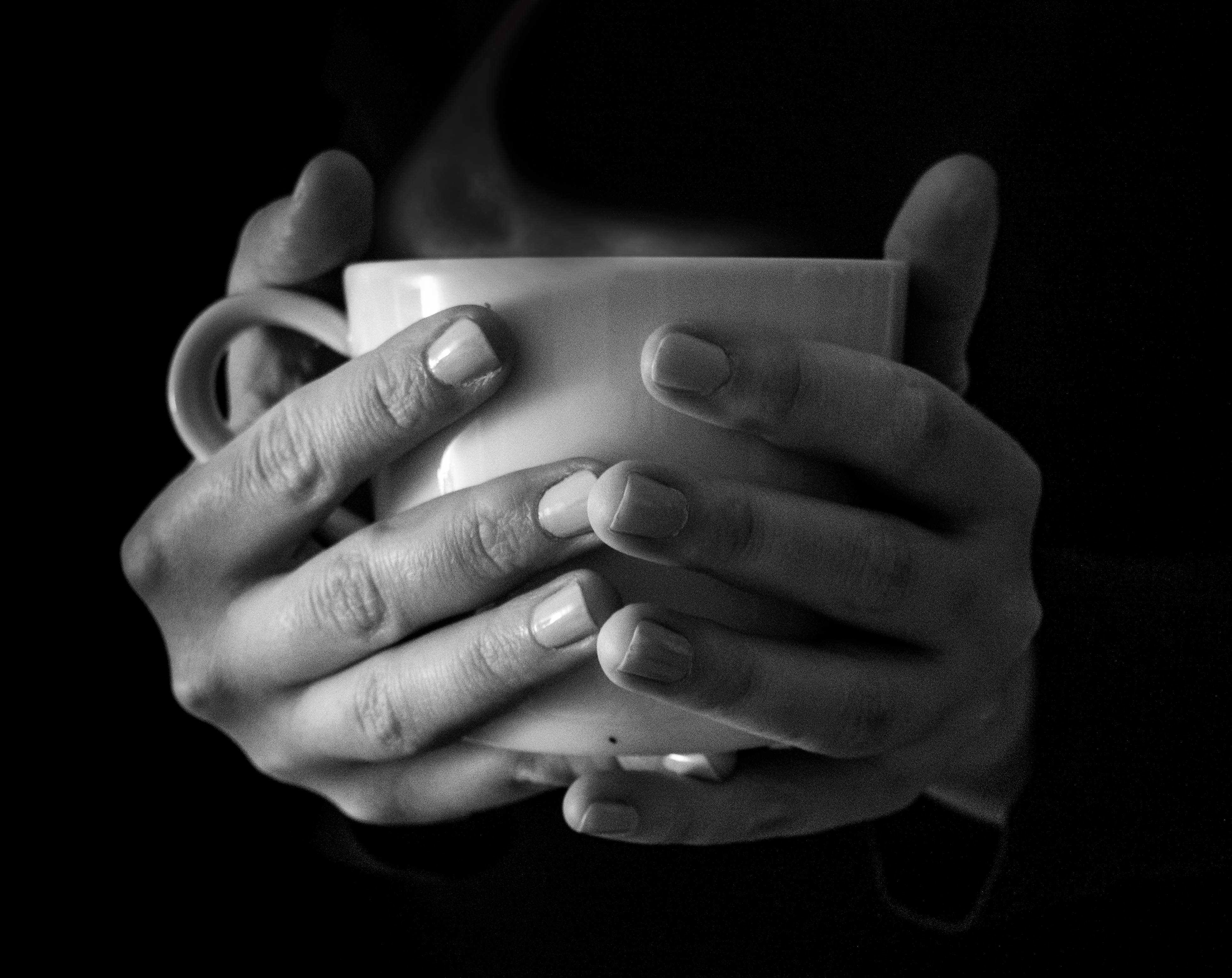
So, surrounded by boxes of paper and stacks of equipment, there is light at the end of the tunnel. I have my cup of Yorkshire tea with soya milk and my gluten free Hob Nob. My studio is feeling a lot like home.

Some of the People and Animals That Have Kept Me Busy Lately

4 Sources of Light For Winter Drawing

Only two weeks away from the shortest day (in the Northern hemisphere), it’s becoming increasingly difficult to draw in the limited winter daylight. Not only has the best of the light gone by 2:30pm but when we do have sun, it is very low in the sky so illumination of the subject and the paper is restricted.

To overcome this there are several options and I have spent the last week comparing four of them. Before I go on, I will just make clear that I’m talking here about quality of light, not about hue. I’ve been sketching with graphite pencil and white paper so the colour of light is irrelevant.

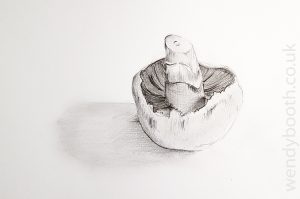
Mushroom in Winter Sunlight

[custom_headline type=”left” level=”h2″ looks_like=”h2″ accent=”true”]Natural Light[/custom_headline]

The first and most obvious form of light is natural light – that big blob of fire in the sky. It may be hiding in the other hemisphere for two thirds of the day and then behind clouds for the rest of it, but it is still there and will always be my favourite kind of illumination.

At this time of year, it is possible to see a phenomenon which is visible all the time, but more evident now: If you are indoors observing an object, say a metre from the window, on an overcast day then you will see two shadows. This is because there are two light sources – the sun itself, and then the glow of the cloud cover. If you were outdoors then the glow from the sky (illuminated from behind by the sun) would be all around and so not so obvious. But, when indoors it will be refined as it is only coming from the direction of the window.

In this case I would generally do what I can to cover the sun because its light will fluctuate, not only in strength as the clouds move by, but also in position as it glides across the winter sky. The beauty of illumination from an overcast sky is its diffused nature and in winter the angle of illumination will be fairly low and eerie.

The best hours of sunlight in midwinter are between 10am and 2pm – on a good day! This isn’t very long at all, and if you don’t have the luxury of these hours to yourself, then winter sun isn’t an option.

[custom_headline type=”left” level=”h2″ looks_like=”h2″ accent=”true”]Multiple Downlights[/custom_headline]

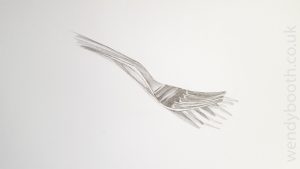
Fork With Multiple Shadows

I would most often draw in this kind of light at home. This is because I draw on the dining table and in this room we have four LED downlights. In general, these lights are great and give good illumination to most of the room whenever required. However, multiple sources of light can be a challenge when drawing. Contrast is drastically reduced. This is a problem because the change in shadow, gives the eye huge clues about the shape of something. The accurate observation of shadow turns a two dimensional object, three dimensional.

Chilli Powder Line Drawing

Four light sources also means four shadows. Describing [extra href=”#example” title=”Form” info=”popover” info_place=”top” info_trigger=”hover” info_content=”Representation of a three-dimensional object in space” ] form [/extra] with multiple light sources can be problematic. But actually I have found this the inspiration for some interesting projects – both replications of the patterns made by four shadows and also some pleasing line drawings where I have been forced to observe contour by ignoring shade altogether.

It may not be considered the ideal light source, but four downlights are the light conditions I use most in winter, just because it involves the least effort to set up!
[custom_headline type=”left” level=”h2″ looks_like=”h2″ accent=”true”]Reading Lamp[/custom_headline]
A strong source of light, in very close proximity, can offer dramatic lighting effects. There will be very little room for gradual change of depth, even on a rounded surface so I find myself trying to find subtleties that perhaps are not there. Also, I find it hard to distinguish patches of dark cast shadow from [extra href=”#example2″ title=”Form Shadow” info=”popover” info_place=”top” info_trigger=”hover” info_content=”The less defined dark side on an object, hidden from the light source” ] form shadow [/extra]. I can’t use the clues I normally would in my drawings as there is so little graduation. I didn’t have much fun with this type of light.

[custom_headline type=”left” level=”h2″ looks_like=”h2″ accent=”true”]Diffused Lamp[/custom_headline]

Diffused Lamp
Diffused Bedside Lamp

This lamp is nothing special – just an old bedside lamp. The kind with a shade. Although this is placed as close to the subject as the reading lamp, the effect is much more subtle. Again drama is created, but the [extra href=”#example” title=”Form” info=”popover” info_place=”top” info_trigger=”hover” info_content=”Representation of a three-dimensional object in space.” ] form [/extra] of an object is easier to represent as graduation is a little softer.  As we aren’t fussy about colour of light at the moment, I’d say this is on a par with the light from an overcast sky – only far more reliable.

Drawing in Diffused Lamp Light

[line]

For representing [extra href=”#example” title=”Form” info=”popover” info_place=”top” info_trigger=”hover” info_content=”Representation of a three-dimensional object in space” ] form [/extra] the diffused lamp gives a better quality of light than the reading lamp and multiple downlights, but for line drawings and interesting effects I am quite happy with the downlights. However, ideally, I would light my subject naturally with overcast sky. If you cannot escape direct sunlight from your window then an overcast-type effect can be achieved with glassine paper at the window or a plain net curtain.

[share title=”Share this Post” facebook=”true” twitter=”true” google_plus=”true” linkedin=”true” pinterest=”true” reddit=”true” email=”true”]

For advice on photography in different light conditions check Photography Guidelines.

Keep It Colour Stupid

Those familiar with my portrait drawings may be forgiven for thinking I only see in sanguine and white. This is something I am very aware of, and for a long time I have been working on incorporating colour into my portraits.

I am not an artist who avoids colour – if you’ve seen my Artfinder and Etsy pages then you’ll know that my problem is more about which medium to settle with! I have worked in oils, watercolour, pro-markers, pastels, coloured pencils… mixed media! There a pros to ALL these media. I would like to say each have their cons, but to be honest I’m not sure I could list them. I love them all!

Another thing the more observant of you will know – I’ve not been around for a while. Our house has been so hectic these last few months. First there was the extension which never materialised, time I’ve spent on other artistic projects, then the summer holidays (impossible to make any plans during this time!) and then we put all the ‘clutter’ into storage with a view to selling the house. Yes, I’m afraid that clutter includes my paints. Believe me, if you’d seen our house before this decluttering then you’d probably agree. Pencils and sketchbooks stayed out – I have to keep some grip on sanity – but even most of my sanguine pencils have been banished to a corrugated tin shed on the other side of town.

The good news is that we have now made some progress with the sale of the house and no longer need to live such a sparse existence. So the watercolours are back in the house!

Why watercolours? Well, they were the first medium I used when I started painting 24 years ago and I’ve always loved their freshness, versatility and personality. Also – they are easy to clean away! Until we move house, my studio is confined to the dining table, and as the kitchen table left in the big clear-out, we really do need that dining table for eating!

You have no idea how excited I am to be painting again. I hope to share some of my work with you soon, and soon after that I might let you see my coloured portraits!

Photography Guidelines

You are probably here because you are considering sending me some photographs to draw. In which case, I encourage to to read this post and consider the principles set out below when choosing/taking your photos. However, we all lead busy lives and I understand many customers don’t have time to read and digest all the information, so if you are just about to click away from the page, then I’d like to draw your attention to just the two MOST IMPORTANT principles. (On the other hand, if you’d just got yourself a cup of tea and put your feet up, then please continue to the end – you’ll be glad you did!):
[content_band bg_color=”#ffe6cc” border=”all” ] [container] [custom_headline style=”margin: 0;” type=”left” level=”h4″ looks_like=”h3″ accent=”true” class=”my-custom-headline”]Daylight and Focus
[/custom_headline]
[icon_list] [icon_list_item type=”sun-o”]Take your photograph outside, out of direct sunlight. Even at midday on a summer’s day it is very hard for a phone camera (or average DSLR lens) to pick up enough light to provide any level of detail whilst indoors.[/icon_list_item] [icon_list_item type=”bullseye”]To gain enough detail for a striking likeness the image must be focussed. Most modern phones make this easy by allowing you simply to touch the area on screen you wish to focus (generally the eye). It is not necessary to create any fancy depth of field or even know what ‘depth of field’ means![/icon_list_item] [/icon_list][/container] [/content_band]
[block_grid type=”two-up”] [block_grid_item] [image src=”http://wendybooth.co.uk/art/wp/wp-content/uploads/2016/03/black-white-photo.jpg” alt=”Backlit photograph for artist commission” type=”thumbnail”][/block_grid_item]

When drawing portraits, there are a few things I need from a photograph that are not necessarily the same things you would want from a portrait photograph. Most modern smartphones are perfectly suitable for photographing portraits and as long as you bear in mind a few simple principles, you will have no problem creating some wonderful images.

Resolution: Most smartphones have great resolution and as long as you take care to focus correctly then it should render enough detail. However, remember that although your phone may take a picture in dim light without flashing, this doesn’t mean it has enough light for a well-rendered picture. Good quality, diffused, daylight is always best (see ‘Light’ section below). To check the level of detail, take a close look at the image. Can you see individual eyelashes and lines on the lips?

Light: I prefer to photograph in natural light – outdoors or close to a window on a bright overcast day. I find this kind of light preferable for all photography and drawing. The diffused nature of the light means the facial features cast soft shadows. Stand the subject so they are facing in the general direction of the light, or up to 45 degrees away, rather than with their back to it.
[/block_grid]

Professional studio photographers will often use diffused flash. This is great if using a single flash placed to the side, or even a single flash and reflector. Too many flashes will remove all shadow, which is great for fashion photography, but not so great for drawing, where some shadow is needed in order to create a three dimensional illusion.

Expression: In my drawings, I like to think I capture a personality rather than a moment in time. So, I encourage you to supply expressions of a pensive nature or a hint of a smile. This also helps with the illusion that the picture was drawn from life.

[block_grid type=”two-up”] [block_grid_item] Permission: If you supply any photographs that you didn’t take yourself then please make sure you have permission of the photographer.

Background: For my pastel portraits, I am drawing the subject’s head. I don’t care what the background looks like!

Finally: I am not judging your skills as a photographer. Just send me a few images and we’ll take it from there. [/block_grid_item] [block_grid_item] [image src=”http://wendybooth.co.uk/art/wp/wp-content/uploads/2016/03/Oscar-Contrast.jpg” alt=”Backlit photograph” type=”thumbnail”] [/block_grid_item]
[/block_grid]

Choosing a Frame

[columnize]Most works on paper require mounting (matting) with acid-free mount board and then framing in order to protect them.

As an artist or collector you will probably already have a strong eye for the right kind of colour but it’s always worth checking the little things. Will the colour of your mount lead the eye to centres of interest in the painting, focus the eye only on areas of shadow or negative space, or point out things you would never have considered, even adding a new dimension to the whole piece? The mount can be considered an extension of the painting’s background so ensure the colour is it subtle enough and of the same palette and warmth as the painting. All good mount suppliers will send samples on request. This makes it easier to see the colour relationships, and can save you a lot of time (and money) but for a rough guide some online stores will show your image superimposed on various mounts and frames. This can be quite a fun way of trying out different scenarios and stumbling on fantastic results you wouldn’t have dared to try otherwise.

The colours in my drawings are quite earthy. I wanted a mount of a much lighter shade than the grey paper but found the bright whites would give my picture a ‘dirtiness’ and compete for attention. I settled for a shade called ‘Snow White’ by Coltswold Mounts. It has a very slight pink tinge and feels as though it’s from the same palette as the earthy red pastel I draw with. The eye is now drawn straight to the picture and it receives all the attention it deserves. A mount’s (and frame’s) job is to present the work – if the first thing you notice is the mount then something is wrong.

Framing is far easier (actually cheaper) if the work is mounted with a standard size frame in mind. Mine allow for a 50 by 60cm size frame. I don’t frame the drawings myself because I find customers far prefer to choose their own.

The most common question, however, is – Should I match a frame to the picture or to my décor? And then the next question – Is it possible to do both?

Firstly, we should consider the style of frame and how the type of frame suits the art. Vibrant or abstract art will often fit best in a plain geometric frame of a black or bold colour.

picture frame

Traditional genres, such as portrait or landscape benefit from a more ornate frame. possibly with some gilt or scrollwork. But, it’s always important to consider the level of detail in the painting – don’t overpower your delicate watercolor with a huge scroll-carved frame.

Also, you will want to consider the style of décor in the home. A dark, classical style will suit the more lavish dark frames, but if the painting itself is rather too delicate for this then perhaps consider an understated dark wood frame.

Something like a drawing or sketch can often be framed in a neutral colour or pale wood and fits well in either contemporary or traditional setting.

So, is it possible to fit the frame to both your art and your décor? With a little careful planning, most definitely, yes![/columnize]