[columnize]This checklist is a much condensed version of my Photography Guidelines article. If you have photographs ready to send me, I would just encourage you to check them against this list:
Resolution: Can you see individual eyelashes and lines on the lips (when zoomed in)? I am not necessarily going to draw every last hair but I can’t create a likeness if the images are vague. The more detail that’s visible, the better.
Light: Good quality daylight is essential. And – I hate to keep giving you rules but – please don’t send me a portrait in silhouette – honestly, this happens a lot!
Permission If somebody else took the photographs you are sending, please make sure you have their permission for me to recreate them.
Finally: I am not judging your skills as a photographer. Just send me a few images and we’ll take it from there.
Whether you want a stunning picture of your elegant hound for the wall, to spam social media with your gorgeous pug or are in need of a detailed reference photograph for an art project – you want the best possible image of your pet and all your have is a smartphone.
Any professional photographer will tell you the key elements of photograph are good light, focus and composition. Of course a swanky DSLR with a super-speedy lens (and a few years photography experience) will almost guarantee your beautiful portrait, but actually a smartphone and a few basic ideas can propel you a long way in the right direction.
Taking Better Pictures of Your Pet With a Smartphone
1) Enough Light
Your camera’s lens reproduces a likeness of the subject by recording the light reflected from it. However good your camera, it can only do this if it picks up enough light. A smartphone will make every attempt to capture an image, so when set to the default “AUTO” setting it will adjust ISO and aperture speed to compensate for low light levels. This is why pictures taken at dusk (for instance) would be grainy and have very low levels of clarity. So it follows that a brighter aspect will allow for a much sharper image.
I prefer to photograph in natural light – close to a window or outdoors on a bright overcast day. A good amount of reflected light will not only feed more information to your lens but allows the lens to work quicker and in the case of animals this can be critical!
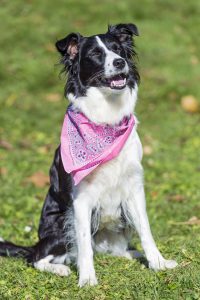
Many pets will be far happier outdoors anyway and this will help with creating an environment your in which your pet feels at ease and often in their element. A Dog Outdoors
2) Focus
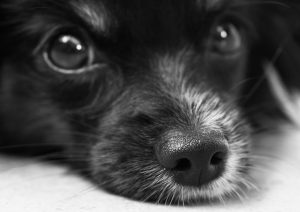
Given the right lighting conditions there is no need to ever take an out-of-focus picture. Smartphones allow you to select the exact spot to focus the image – which in most cases should be the eye. You can experiment with focussing on different spots. The example below focusses on the nose. It draws attention away from the eye and distances us from the animal. When capturing a portrait this is rarely a favourable look. Use Smartphone to Select Area of Focus
3) Avoid Blur
In terms of clarity this is similar to the above. However, it may not be as easy to address. Your pet is lively and doesn’t like to pose for the camera. You could go through any number of ways to tempt them to stay still – plenty of hints can be found here on RedBarn Inc but if all else fails how about just having someone hold the pet on a close rein and you can get in and take a cropped portrait eliminating all exterior clutter – and people.
Cropped Portrait Eliminating All Clutter
The ultimate way to avoid movement is to snap your pet while they’re sleeping. This often catches them at their cutest and can make a really quirky portrait. See this article from Digital Photography Review for some great examples.
4) Background
A busy background can be very distracting – and if your house is anything like mine this is difficult to avoid! Another good reason to take your pet outdoors. Even if you can’t find a suitable vista to place your animal, you can always stand above him/her and make a background out of the ground.
5) Make it Natural
A posed photograph is hard to get, even with the best trained animal, but in general a natural candid portrait is going to show your pet’s character and additionally gives the photographer more freedom.
Give yourself, and your pet, plenty of time to relax. Follow him round with the camera and expect to take lots of really awful pictures – that’s the great thing about digital photography – you can delete the failures and all it cost was your time. Eventually you’re patience will pay off.
Kitten Captured in a Natural Pose
6) Plan Ahead
It’s all very well dragging your pet outside when the light is right and he’s in a good mood – but if you have to dash off on the school run in 15 minutes then you’re not relaxed and you will both soon feel the stress. If you think of this as a professional photo-shoot then you may consider that your time is valuable, you will possibly (probably!) do a better job without the kids in tow and that you may even have a better chance at success if you draw up a plan. Give yourself lots of opportunities to try different shots, give yourself breaks and then when you do eventually check through your many attempts you may find some nice surprises.
You are probably here because you are considering sending me some photographs to draw. In which case, I encourage to to read this post and consider the principles set out below when choosing/taking your photos. However, we all lead busy lives and I understand many customers don’t have time to read and digest all the information, so if you are just about to click away from the page, then I’d like to draw your attention to just the two MOST IMPORTANT principles. (On the other hand, if you’d just got yourself a cup of tea and put your feet up, then please continue to the end – you’ll be glad you did!):
[content_band bg_color=”#ffe6cc” border=”all” ] [container] [custom_headline style=”margin: 0;” type=”left” level=”h4″ looks_like=”h3″ accent=”true” class=”my-custom-headline”]Daylight and Focus [/custom_headline]
[icon_list] [icon_list_item type=”sun-o”]Take your photograph outside, out of direct sunlight. Even at midday on a summer’s day it is very hard for a phone camera (or average DSLR lens) to pick up enough light to provide any level of detail whilst indoors.[/icon_list_item] [icon_list_item type=”bullseye”]To gain enough detail for a striking likeness the image must be focussed. Most modern phones make this easy by allowing you simply to touch the area on screen you wish to focus (generally the eye). It is not necessary to create any fancy depth of field or even know what ‘depth of field’ means![/icon_list_item] [/icon_list][/container] [/content_band]
[block_grid type=”two-up”] [block_grid_item] [image src=”http://wendybooth.co.uk/art/wp/wp-content/uploads/2016/03/black-white-photo.jpg” alt=”Backlit photograph for artist commission” type=”thumbnail”][/block_grid_item]
When drawing portraits, there are a few things I need from a photograph that are not necessarily the same things you would want from a portrait photograph. Most modern smartphones are perfectly suitable for photographing portraits and as long as you bear in mind a few simple principles, you will have no problem creating some wonderful images.
Resolution: Most smartphones have great resolution and as long as you take care to focus correctly then it should render enough detail. However, remember that although your phone may take a picture in dim light without flashing, this doesn’t mean it has enough light for a well-rendered picture. Good quality, diffused, daylight is always best (see ‘Light’ section below). To check the level of detail, take a close look at the image. Can you see individual eyelashes and lines on the lips?
Light: I prefer to photograph in natural light – outdoors or close to a window on a bright overcast day. I find this kind of light preferable for all photography and drawing. The diffused nature of the light means the facial features cast soft shadows. Stand the subject so they are facing in the general direction of the light, or up to 45 degrees away, rather than with their back to it.
[/block_grid]
Professional studio photographers will often use diffused flash. This is great if using a single flash placed to the side, or even a single flash and reflector. Too many flashes will remove all shadow, which is great for fashion photography, but not so great for drawing, where some shadow is needed in order to create a three dimensional illusion.
Expression: In my drawings, I like to think I capture a personality rather than a moment in time. So, I encourage you to supply expressions of a pensive nature or a hint of a smile. This also helps with the illusion that the picture was drawn from life.
[block_grid type=”two-up”] [block_grid_item] Permission: If you supply any photographs that you didn’t take yourself then please make sure you have permission of the photographer.
Background: For my pastel portraits, I am drawing the subject’s head. I don’t care what the background looks like!
Finally: I am not judging your skills as a photographer. Just send me a few images and we’ll take it from there. [/block_grid_item] [block_grid_item] [image src=”http://wendybooth.co.uk/art/wp/wp-content/uploads/2016/03/Oscar-Contrast.jpg” alt=”Backlit photograph” type=”thumbnail”] [/block_grid_item]
[/block_grid]